Un peu d’histoire

Sur la proposition du cabinet impérial de Russie, une commission militaire internationale ayant été réunie à St-Pétersbourg, afin d’examiner la convenance d’interdire l’usage de certains projectiles en temps de guerre entre les nations civilisées, et cette commission ayant fixé, d’un commun accord, les limites techniques où les nécessités de la guerre doivent s’arrêter devant les exigences de l’humanité, les soussignés sont autorisés, par les ordres de leurs gouvernements, à déclarer ce qui suit :

  • Considérant que les progrès de la civilisation doivent avoir pour effet d’atténuer autant que possible les calamités de la guerre;
  • Que le seul but légitime que les Etats doivent se proposer, durant la guerre, est l’affaiblissement des forces militaires de l’ennemi;
  • Qu’à cet effet, il suffit de mettre hors de combat le plus grand nombre d’hommes possible;
  • Que ce but serait dépassé par l’emploi d’armes qui aggraveraient inutilement les souffrances des hommes mis hors de combat ou voudraient leur mort inévitable;
  • Que l’emploi de pareilles armes serait, dès lors, contraire aux lois de l’humanité;
Sur l’invitation du diplomate et homme d’État russe, le Prince Alexander Gortchakov, dans le but d’examiner les règles existantes de la guerre, une conférence des délégués s’est tenue à Saint-Pétersbourg, Empire russe en Décembre 1868.

DECLARATION DE St PETERSBOURG DU 29 NOV. – 11 DEC. 1868

Les parties contractantes s’engagent à renoncer mutuellement, en cas de guerre entre elles, à l’emploi, par leurs troupes de terre ou de mer, de tout projectile d’un poids inférieur à 400 grammes qui serait ou explosible ou chargé de matières fulminantes ou inflammables.

Elles inviteront tous les Etats qui n’ont pas participé, par l’envoi de délégués, aux délibérations de la commission militaire internationale réunie à St-Pétersbourg, à accéder au présent engagement.

Cet engagement n’est obligatoire que pour les parties contractantes ou accédantes, en cas de guerre entre deux ou plusieurs d’entre elles; il n’est pas applicable vis-à-vis de parties non contractantes ou qui n’auraient pas accédé.

Il cesserait également d’être obligatoire du moment où, dans une guerre entre parties contractantes ou accédantes, une partie non contractante ou qui n’aurait pas accédé se joindrait à l’un des belligérants.

Les parties contractantes ou accédantes, se réservent de s’entendre ultérieurement, toutes les fois qu’une proposition précise serait formulée en vue des perfectionnements a venir que la science pourrait apporter dans l’armement des troupes, afin de maintenir les principes qu’elles ont posés et de concilier les nécessités de la guerre avec les lois de l’humanité.

Fait à St-Pétersbourg, le 29 Novembre-11 décembre 1868.                  (Signatures)

ÉTATS PARTIES   Signature   Ratification / Adhésion
Autriche-Hongrie   11.12.1868   11.12.1868
Bade   11.01.1869
Bavière   11.12.1868   11.12.1868
Belgique   11.12.1868   11.12.1868
Brésil   23.10.1869
Danemark   11.12.1868   11.12.1868
Estonie   08.10.1991
Fédération de Russie   11.12.1868   11.12.1868
France   11.12.1868   11.12.1868
Grèce   11.12.1868   11.12.1868
Italie   11.12.1868   11.12.1868
Pays-Bas   11.12.1868   11.12.1868
Perse   11.12.1868   11.12.1868
Portugal   11.12.1868   11.12.1868
Prusse et Confédération de l’Allemagne du Nord   11.12.1868   11.12.1868
Royaume-Uni de Grande-Bretagne et d’Irlande du Nord   11.12.1868   11.12.1868
Suède et Norvège   11.12.1868   11.12.1868
Suisse   11.12.1868   11.12.1868
Turquie   11.12.1868   11.12.1868
Wurtemberg   11.12.1868   11.12.1868

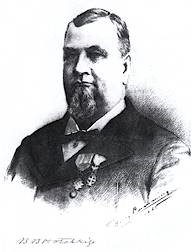
Benjamin Berkeley Hotchkiss est né aux Etats-Unis, à Watertown, Connecticut, le 1er Octobre 1826.

Dans son enfance, il a déménagé à Sharon, Connecticut où il a commencé à travailler dans l’usine paternelle. À partir des années 1850, il a fait son apprentissage comme armurier à Hartford à la Colt’s Patent Arms Co. Il a ensuite participé à l’amélioration des revolvers Colt.

Diverses armes et projectiles qu’il aura mis au point seront utilisés pendant la guerre de Sécession de 1861 à 1865.
Puis, en 1867, le gouvernement américain n’ayant montré que peu d’intérêt pour le financement de nouvelles armes, B. Hochkiss, estimant ne pas bénéficier de la reconnaissance qu’il méritait, s’installe en France à Viviez près de Rodez et travaille sur le remplacement par une cartouche métallique de la fragile cartouche en papier du fusil français Chassepot modèle 1866.
Le Gouvernement français, satisfait de ses travaux, ordonne la fabrication immédiate de cette cartouche à Saint-Etienne et, en passant des commandes pour un nouveau canon, incite B. Hotchkiss à rester en France et à développer une mitrailleuse à canons rotatifs. Néanmoins ce dernier est déjà persuadé d’une plus grande efficacité d’une telle arme en combinant la rapidité de tir de la mitrailleuse à l’effet destructeur de l’obus explosif.
Mais en 1871 son canon-revolver ne sera pas au point pour armer les troupes françaises pendant la guerre franco-prussienne de 1870-1871.

Il est intéressant de noter que la Convention de Saint-Pétersbourg de 1868 limitait le poids d’un projectile explosif à 1 livre, soit 450 grammes.
B. Hotchkiss retiendra un minimum de 455 grammes et ses calculs l’amèneront à un compromis « poids total – charge d’explosif – équilibrage » débouchant sur un calibre approprié de 37mm.

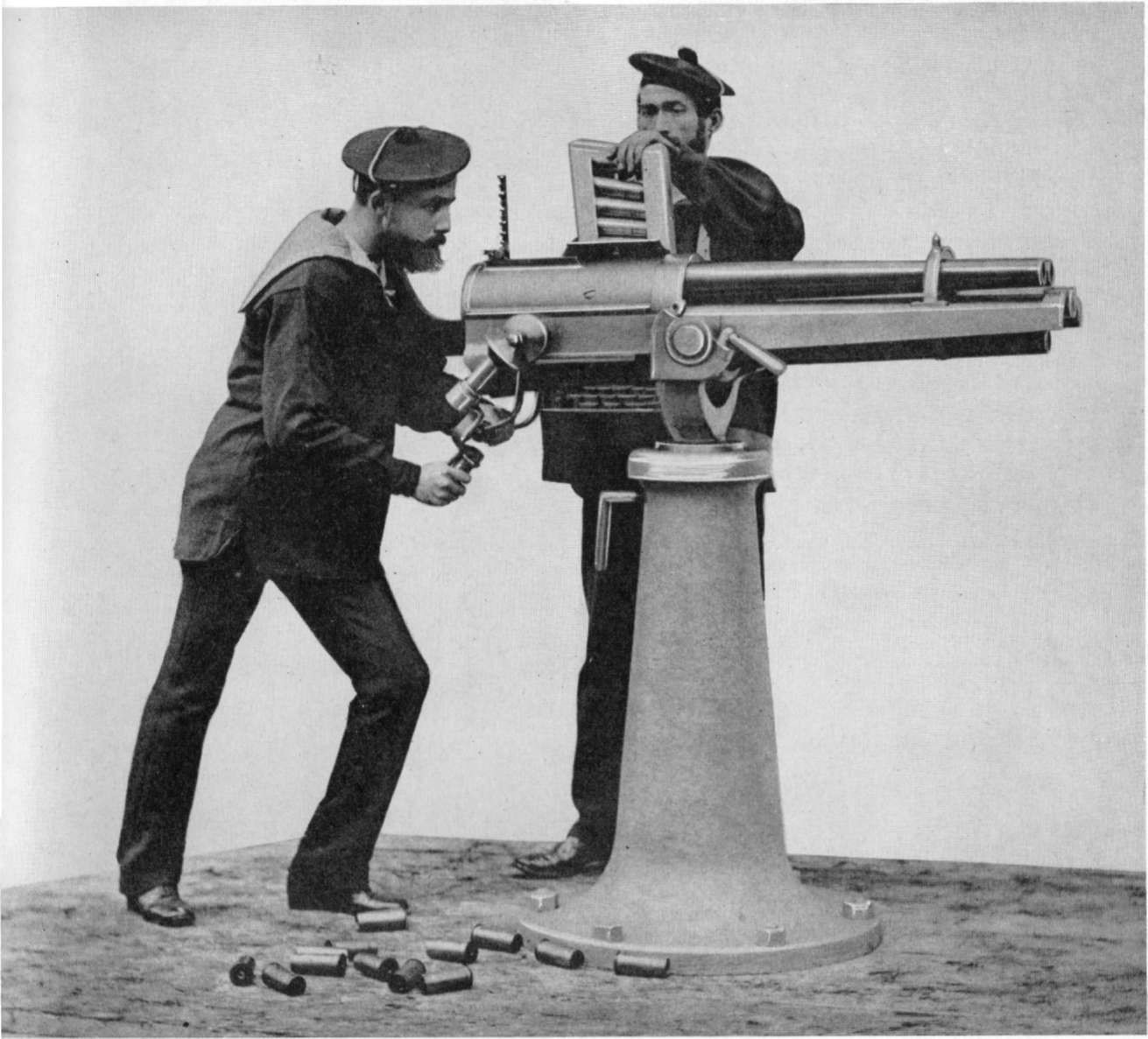
Le rapport poids canon / projectile engendre un faible recul de l’arme et permet à un homme seul de la manœuvrer. Toutefois, l’équipage était composé général d’un chargeur, d’un opérateur et d’un tireur actionnant la manivelle.

Par ailleurs, sa conception originale permet un démontage complet de l’arme sans l’aide d’outils.

En 1873, des essais sont effectués aux ateliers de la Marine française à Gâvres à la demande et avec l’aide du Ministère Français de la Marine. Ces essais aboutiront à la mise au point par les techniciens français du canon-revolver… pour lequel B. Hotchkiss déposera les brevets et entamera deux autres années de développements et d’expérimentations.

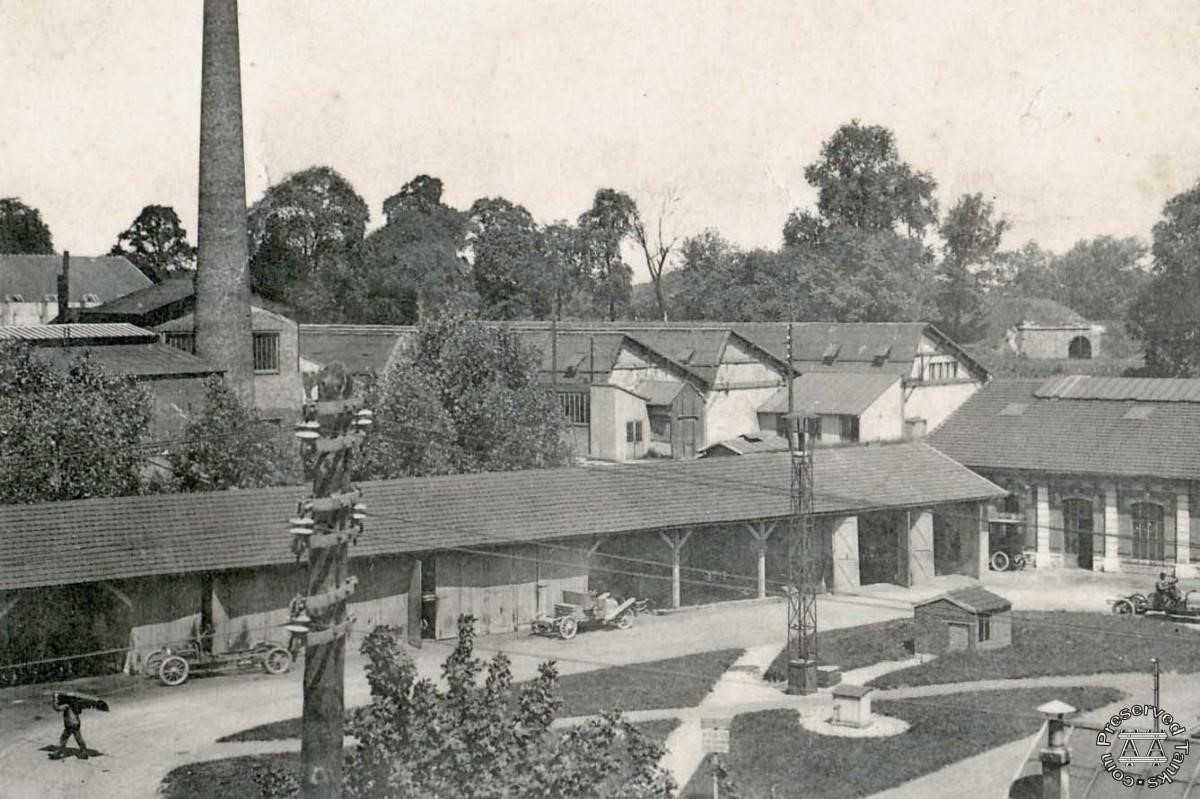
En 1875, la société Hotchkiss & Co., installe ses bureaux à Paris et une usine de fabrication dans la ville voisine de Saint-Denis. Elle était destinée à fabriquer, non seulement l’arme elle-même, mais aussi les munitions. Elle emploiera jusqu’à un millier de personnes.

A partir de 1876, la mise au point des navires torpilleurs à grande vitesse apparaît comme une nouvelle arme de guerre navale et crée la demande pour un nouveau type d’arme pour la défense navale qui combinerait puissance destructrice, rapidité de tir, précision et fiabilité.
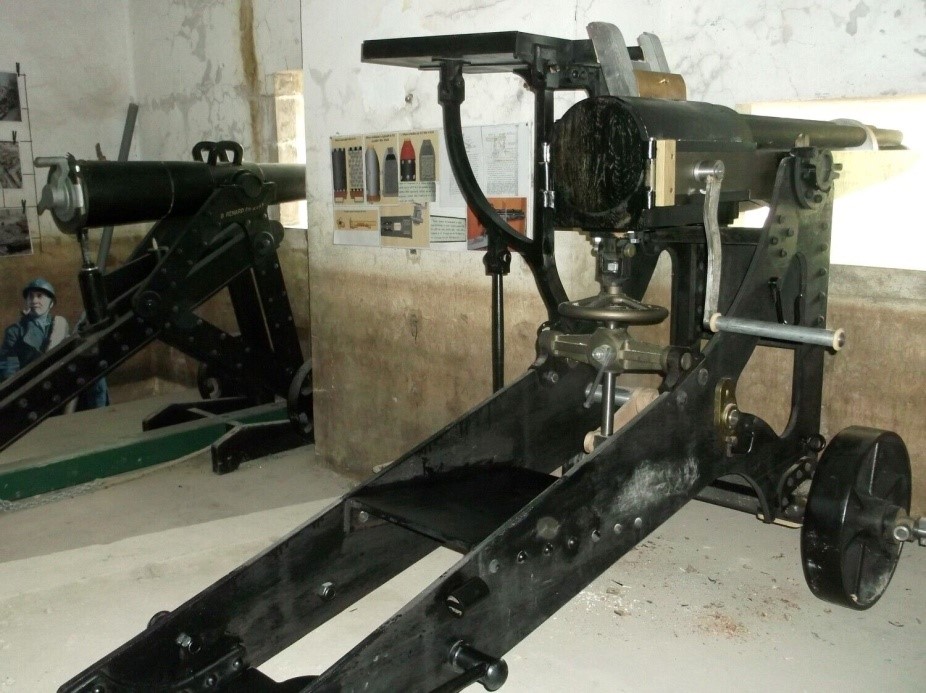
En 1879, la France adopte le canon-revolver Hotchkiss de 40mm pour équiper les défenses des forts Serré de Rivière en construction .La particularité de cette arme est que le pas des rayures des cinq canons sont différents et permet de balayer totalement la zone cible avec 1500 à 2000 projectiles mortels à partir d’une salve de 60 à 80 coups en une minute.
Certains de ces canons seront toujours en service en 1940 dans la région d’Epinal (Est de la France).

En 1884, l’activité se développant au delà de l’usine de Saint-Denis, une association se crée avec la société britannique William Armstrong & Co.
A sa mort, au sommet de sa gloire, le 14 février 1885, Benjamin Hotchkiss avait la réputation d’être le meilleur ingénieur en armement au monde.
En 1887, les deux sociétés, placées sous le contrôle de la société française sont rebaptisées respectivement Société Anonyme des Anciens Etablissements Hotchkiss et Cie en France, et Hotchkiss Ordnance Co.Ltd en Angleterre.
En 1891, la société acquiert divers brevets lui permettant notamment la fabrication de mitrailleuses et crée pour cela une nouvelle usine près de Paris.
A cette date, depuis sa création, la société Hotchkiss aura livré, rien qu’à la marine française, plus de 10 000 canons-revolver et 4 millions de cartouches.

Le canon-revolver Hotchkiss, décliné en quatre calibres, de 37mm à 57mm, soit de 1 livre à 6 livres, aura été adopté par l’Allemagne, l’Angleterre, l’Argentine, l’Autriche, le Brésil, le Chili, la Chine, le Danemark, les Etats-Unis, la France, les Pays-Bas, l’Italie, la Norvège, la Russie, la Turquie, …

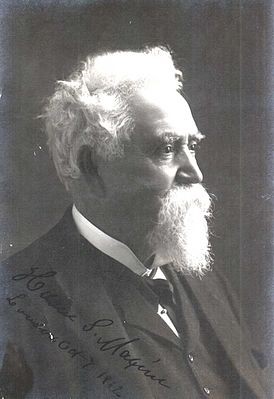
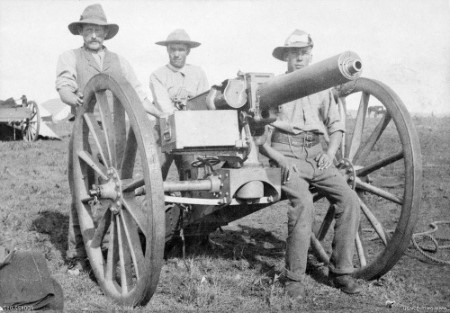
Parallèlement, à la fin des années 1880, le britannique d’origine américaine Hiram Maxim (1840-1916) conçoit un canon qui est une version agrandie de sa mitrailleuse Maxim.

Les projectiles respectant les conditions de la déclaration de Saint Pétersbourg seront eux aussi d’un calibre de 37mm pour un poids d’une livre.
Contrairement au canon-revolver Hotchkiss, actionné manuellement, le canon maxim est alimenté automatiquement.

Cette arme, proposée sous la marque Maxim-Nordenfeld en 1898 à l’armée britannique, qui la refuse l’estimant trop chère et inutile, est achetée, entre autres, par le République d’Afrique du Sud (Transvaal), et sera utilisée contre les Britanniques pendant la seconde guerre des Boers de 1899 à 1902 en utilisant des munitions d’origine allemande.

La Grande-Bretagne s’équipe donc de ces mêmes canons fabriqués par VSM – Vickers, Sons and Maxim, et les utilisera également pendant la première guerre mondiale.

A little history – Why 37 mm ?

On the proposition of the Imperial Cabinet of Russia, an International Military Commission having assembled at St. Petersburg in order to examine the expediency of forbidding the use of certain projectiles in time of war between civilized nations, and that Commission having by common agreement fixed the technical limits at which the necessities of war ought to yield to the requirements of humanity, the Undersigned are authorized by the orders of their Governments to declare as follows:

Considering :

  • That the progress of civilization should have the effect of alleviating as much as possible the calamities of war;
  • That the only legitimate object which States should endeavour to accomplish during war is to weaken the military forces of the enemy;
  • That for this purpose it is sufficient to disable the greatest possible number of men;
  • That this object would be exceeded by the employment of arms which uselessly aggravate the sufferings of disabled men, or render their death inevitable;
  • That the employment of such arms would, therefore, be contrary to the laws of humanity;

At the invitation of the Russian diplomat and statesman Petersburg, Russian Empire in December 1868., Prince Alexander Gorchakov, for the purpose of examining the existing rules of war, a conference of delegates was held in St.

St PETERSBURG – 29 NOV. – 11 DEC. 1868

The Contracting Parties engage mutually to renounce, in case of war among themselves, the employment by their military or naval troops of any projectile of a weight below 400 grammes, which is either explosive or charged with fulminating or inflammable substances.

They will invite all the States which have not taken part in the deliberations of the International Military Commission assembled at St. Petersburg by sending Delegates thereto, to accede to the present engagement.

This engagement is compulsory only upon the Contracting or Acceding Parties thereto in case of war between two or more of themselves; it is not applicable to non-Contracting Parties, or Parties who shall not have acceded to it.

It will also cease to be compulsory from the moment when, in a war between Contracting or Acceding Parties, a non-Contracting Party or a non-Acceding Party shall join one of the belligerents.

The Contracting or Acceding Parties reserve to themselves to come hereafter to an understanding whenever a precise proposition shall be drawn up in view of future improvements which science may effect in the armament of troops, in order to maintain the principles which they have established, and to conciliate the necessities of war with the laws of humanity.

Done at St. Petersburg, 29 November (11 December) 1868. (Here follow signatures)

STATES PARTIES   Signature   Ratification                   .     / Adhésion Réserve/ Déclaration
Austria-Hungary   11.12.1868   11.12.1868
Baden   11.01.1869
Bavaria   11.12.1868   11.12.1868
Belgium   11.12.1868   11.12.1868
Brazil   23.10.1869
Denmark   11.12.1868   11.12.1868
Estonia   08.10.1991
Russian Federation   11.12.1868   11.12.1868
France   11.12.1868   11.12.1868
Greece   11.12.1868   11.12.1868
Italy   11.12.1868   11.12.1868
Netherlands   11.12.1868   11.12.1868
Persia   11.12.1868   11.12.1868
Portugal   11.12.1868   11.12.1868
Prussia and the North Geman Confederation   11.12.1868   11.12.1868
United Kingdom of Great Britain and Northern Ireland   11.12.1868   11.12.1868
Sweden and Norway   11.12.1868   11.12.1868
Swizerland   11.12.1868   11.12.1868
Turkey   11.12.1868   11.12.1868
Württemberg   11.12.1868   11.12.1868

Benjamin Berkeley Hotchkiss was born in the United States, in Watertown, Connecticut, on October 1, 1826. As a child, he moved to Sharon, Connecticut, where he began working in his father’s factory. Beginning in the 1850s, he apprenticed as a gunsmith in Hartford at Colt’s Patent Arms Co. He later participated in the improvement of Colt revolvers.

Various weapons and projectiles that he developed were used during the American Civil War from 1861 to 1865.

Then, in 1867, with the US government showing little interest in funding new weapons, B. Hochkiss, feeling he was not receiving the recognition he deserved, moved to France to Viviez near Rodez and worked on replacing the fragile paper cartridge in the French Chassepot Model 1866 rifle with a metal cartridge.

The French government, satisfied with his work, ordered the immediate manufacture of this cartridge in Saint-Etienne and, by placing orders for a new gun, encouraged B. Hotchkiss to stay in France and develop a machine gun with rotating barrels. However, the latter was already convinced of the greater effectiveness of such a weapon by combining the rapid fire of the machine gun with the destructive effect of the explosive shell.

But in 1871 his revolver-cannon was not ready to arm the French troops during the Franco-Prussian War of 1870-1871.

It is interesting to note that the St. Petersburg Convention of 1868 limited the weight of an explosive projectile to 1 pound, or 450 grams.

B. Hotchkiss will retain a minimum of 455 grams and his calculations will lead him to a compromise « total weight – explosive charge – balancing » resulting in an appropriate caliber of 37mm.

The gun’s barrel-to-projectile weight ratio results in low recoil, allowing the weapon to be operated by a single man. However, the crew generally consisted of a loader, an operator, and a gunner operating the crank. Furthermore, its original design allows for complete disassembly of the weapon without the use of tools.

In 1873, tests were carried out at the French Navy workshops in Gâvres at the request and with the assistance of the French Ministry of the Navy. These tests led to the development by French technicians of the revolver cannon… for which B. Hotchkiss filed the patents and began two more years of development and experimentation.

In 1875, Hotchkiss & Co. established its offices in Paris and a manufacturing plant in the nearby town of Saint-Denis. It was intended to manufacture not only the weapon itself, but also the ammunition. It would employ up to a thousand people.

From 1876 onwards, the development of high-speed torpedo boats emerged as a new weapon of naval warfare and created the demand for a new type of weapon for naval defence which would combine destructive power, speed of fire, precision and reliability.

In 1879, France adopted the 40mm Hotchkiss revolver cannon to equip the defenses of the Serré de Rivière forts under construction on the country’s borders. The unique feature of this weapon was that the rifling of the five barrels was different, allowing it to completely sweep the target area with 1,500 to 2,000 deadly projectiles from a salvo of 60 to 80 rounds per minute.

Some of these cannons were still in service in 1940 in the Epinal region (eastern France).

In 1884, as the business expanded beyond the Saint-Denis factory, an association was formed with the British company William Armstrong & Co.

At the time of his death, at the height of his fame, on February 14, 1885, Benjamin Hotchkiss had the reputation of being the best weapons engineer in the world.

In 1887, the two companies, placed under the control of the French company, were renamed respectively Société Anonyme des Anciens Etablissements Hotchkiss et Cie in France, and Hotchkiss Ordnance Co. Ltd in England.

In 1891, the company acquired various patents allowing it to manufacture machine guns and created a new factory near Paris for this purpose.

By this date, since its creation, the Hotchkiss company will have delivered, to the French Navy alone, more than 10,000 revolver cannons and 4 million cartridges.

The Hotchkiss revolver cannon, available in four calibers, from 37mm to 57mm, or from 1 pound to 6 pounds, was adopted by Germany, England, Argentina, Austria, Brazil, Chile, China, Denmark, the United States, France, the Netherlands, Italy, Norway, Russia, Turkey, etc.

Meanwhile, in the late 1880s, the British-born American Hiram Maxim (1840-1916) designed a cannon that was an enlarged version of his Maxim machine gun.

The projectiles meeting the conditions of the St. Petersburg Declaration will also be of 37mm calibre and weigh one pound.

Unlike the manually operated Hotchkiss revolver cannon, the Maxim cannon is automatically fed.

This weapon, offered under the Maxim-Nordenfeld brand in 1898 to the British army, which refused it as too expensive and useless, was purchased, among others, by the Republic of South Africa (Transvaal), and was used against the British during the Second Boer War from 1899 to 1902 using ammunition of German origin.

Great Britain therefore equipped itself with these same cannons manufactured by VSM – Vickers, Sons and Maxim, and would also use them during the First World War.